
The quick answer (so you can sanity-check quotes fast)
If you’re researching ecommerce website cost uk, most builds land in one of three bands:
- Starter shop (launch-ready, simple catalogue): ~£1,500–£4,000
- Growing brand (better UX, automation, integrations): ~£4,000–£12,000
- Advanced shop (complex shipping/tax, subscriptions, B2B, custom logic): ~£12,000–£35,000+
Then comes the ongoing reality: your ecommerce website cost per month is usually £60–£600+ depending on platform, apps/plugins, support, and how “hands-on” you want to be.
Those ranges aren’t random. They’re basically the sum of:
- platform + hosting
- Theme/design + build
- Apps/plugins
- Product setup + merchandising
- Shipping/tax rules
- Maintenance + improvements.
Platform cost ranges (Shopify vs WooCommerce vs “custom”)
Shopify website cost UK (subscription + build)
Typical UK subscription: Shopify’s core plans commonly start from £19/month (billed yearly) for Basic, then scale up by plan. Shopify
Payment processing: If you use Shopify Payments, Shopify lists online card rates starting at 2% + 25p (plan-dependent). Shopify
Build costs (one-off):
- Template-based Shopify build: ~£1,500–£5,000
- Semi-custom (custom sections, better merchandising, speed/SEO basics): ~£4,000–£12,000
- Heavily custom Shopify theme / advanced integrations: ~£12,000–£30,000+
What you’re paying for: Shopify is the “it just works” option. Hosting, security, updates, and a lot of ecommerce plumbing are handled for you. You usually pay more in subscriptions/apps, but you reduce technical overhead.
When Shopify tends to be best value:
- You want a reliable platform fast
- You don’t want to think about hosting, caching, updates, or plugin conflicts
- You’re happy to use apps for features like bundles, subscriptions, reviews, etc.
WooCommerce website cost UK (plugin is free… the ecosystem isn’t)
WooCommerce itself is a WordPress plugin, so you don’t pay a platform subscription in the same way. Your costs shift into hosting + extensions + maintenance.
Build costs (one-off):
- Starter WooCommerce shop (good theme, clean checkout, basic shipping): ~£2,000–£6,000
- Growing shop (custom design, improved filters, automation, CRM/email integration): ~£5,000–£15,000
- Advanced WooCommerce (complex shipping, multi-warehouse, subscriptions, B2B pricing, bespoke logic): ~£12,000–£40,000+
Ongoing costs (typical monthly equivalents):
- Hosting: ~£10–£80+/month (more if high traffic or managed Woo hosting)
- Paid plugins/extensions: ~£10–£200+/month equivalent (often billed yearly)
- Maintenance/support: ~£50–£400+/month depending on coverage
What you’re paying for: flexibility and ownership. WooCommerce can do almost anything—but the more you customise, the more you need proper maintenance and performance care.
When WooCommerce tends to be best value:
- Content + SEO is a major strategy (blogs, guides, landing pages, programmatic SEO)
- You want full control of site structure and functionality
- You want to avoid being locked into a platform ecosystem
Custom ecommerce (headless / bespoke) — powerful, but rarely step one
A fully custom build (or “headless” setup) can make sense for high-volume brands, unusual product configuration, or serious performance needs.
Typical costs:
- Build: ~£25,000–£150,000+
- Ongoing: often £500–£5,000+/month once you include hosting, monitoring, development retainers, and ongoing optimisation.
Most businesses don’t need this at launch. It’s usually the “we’ve outgrown normal tools” move, not the “I’m opening my first shop” move.
What’s usually included in ecommerce build quotes (and what often isn’t)
Here’s what a sensible online store cost uk quote typically includes:
Included (should be):
- Store structure: categories/collections, search basics, navigation
- Core pages: home, product, category, cart, checkout, policies, contact
- Payment setup (e.g., Stripe/PayPal/Shopify Payments) and basic testing
- Shipping setup (basic zones/rates) and tax/VAT basics
- Mobile-first design + essential UX (trust signals, clear CTAs, readable checkout)
- Speed/SEO fundamentals: clean URLs, metadata, indexing basics, image optimisation
- Analytics: GA4 and basic conversion tracking setup
- Security basics (especially for WordPress/Woo)
- A handover/training session + documentation
Often NOT included (or only partially):
- Product upload at scale (especially if you have 200+ SKUs)
- Copywriting and product descriptions
- Photography, video, and creative direction
- Advanced email flows (welcome, abandon cart, post-purchase sequences)
- Deep CRO (conversion rate optimisation) and ongoing A/B testing
- Ongoing SEO/content marketing
- Complex shipping rules, returns portals, subscription logic, B2B pricing tiers
If two quotes are far apart, it’s usually because one includes the unglamorous heavy lifting (product setup, shipping logic, QA, tracking) and the other… quietly doesn’t.
Ecommerce website cost UK per month (the stuff that sneaks up on you)
Think of monthly cost as four buckets:
1) Platform / hosting
- Shopify: subscription (commonly from £19/month billed yearly on Basic) Shopify
- WooCommerce: hosting (shared → VPS → managed) depending on traffic and performance needs
2) Apps / plugins
Common recurring tools (both platforms):
- Reviews, loyalty, referrals
- Email marketing integrations
- Bundles/upsells/cross-sells
- Subscriptions or membership features
- Product filters and search enhancements
- Fraud prevention, address validation
A lean store might run £0–£60/month here. A serious growth store can hit £150–£500+/month once you stack “just one more app”.
3) Payment fees (transaction costs)
Payment processing is usually a percentage + fixed fee per transaction. Shopify publishes starting rates for online card payments on its pricing page (plan-dependent). Shopify
For WooCommerce, your gateway (e.g., Stripe/PayPal) charges processing fees, and you may also have plugin costs for certain payment methods.
Practical takeaway: fees matter more as revenue scales. A slightly higher conversion rate often beats obsessing over a 0.2% fee difference.
4) Maintenance + support (especially for WooCommerce)
- Shopify: less technical maintenance, more “store ops” maintenance (apps, theme tweaks, merchandising)
- WooCommerce: updates, backups, security hardening, performance tuning, plugin compatibility checks
Even a small store benefits from a basic care plan—because broken checkouts are a truly cursed way to spend a Tuesday.
The biggest price drivers (why “just a small shop” sometimes isn’t)
Product count and catalogue complexity
It’s not only how many products—you pay for:
- Variations (size/colour/material), bundles, kits
- Filters, sorting, and “find the right one” UX
- Bulk import cleanup (CSV hygiene is… an art form)
Rule of thumb:
- Up to ~20 products: setup is manageable
- 50–200 products: needs process + import + QA
- 200+ products: you’re designing a merchandising system, not “adding products”
Shipping complexity
Shipping is where ecommerce dreams go to wrestle spreadsheets.
Cost increases with:
- Multiple couriers
- Variable rates by weight, size, region, or product type
- Multi-warehouse fulfilment
- Click & collect, delivery slots, or local delivery rules
- Returns portals and label generation
Tax/VAT and international selling
Things that add build time:
- VAT logic (especially mixed-rate goods)
- EU/UK/IOSS-style considerations (if applicable)
- Multi-currency pricing rules
- Duties/taxes messaging at checkout
Three example builds (realistic “what you get” snapshots)
These are illustrative ranges (not magic numbers), but they map well to typical UK quotes.
Example 1 — Starter shop (launch fast, sell the basics)
Best for: new brands, small catalogues, simple fulfilment
One-off build: £1,500–£4,000
Monthly running cost: ~£60–£250/month (platform/hosting + a few essentials)
Includes:
- Clean template/theme setup + light custom styling
- 5–10 core pages + essential policies
- Up to ~20 products set up (or a guided import)
- Basic shipping zones + VAT basics
- Payment setup + checkout testing
- Basic analytics + SEO fundamentals
Where it compromises:
- Limited custom functionality
- Minimal automation (email flows, segmentation)
- Basic filters/search
Example 2 — Growing brand (better UX, better conversion)
Best for: established sellers, paid ads traffic, expanding catalogue
One-off build: £4,000–£12,000
Monthly running cost: ~£150–£500/month
Includes:
- Customised design system (not just “theme colours”)
- Stronger product discovery (collections, filters, on-site search improvements)
- Upsells/cross-sells, bundles, reviews
- Email marketing integration + core flows
- Improved tracking (events, funnels) and conversion QA
- Shipping rules beyond the basics
Where it compromises:
- Still app/plugin-driven for advanced features
- Bespoke logic may be limited unless budget grows
Example 3 — Advanced shop (complex operations, serious features)
Best for: high SKU counts, subscriptions, B2B, or complex fulfilment
One-off build: £12,000–£35,000+
Monthly running cost: ~£300–£1,500+/month (support + tools + infrastructure)
Includes:
- Highly refined UX + performance work
- Advanced shipping logic and/or multi-warehouse fulfilment
- Subscriptions/memberships or B2B pricing tiers
- Custom integrations (ERP/CRM/accounting) where needed
- Structured SEO for large catalogues (technical + content architecture)
- Ongoing optimisation roadmap (CRO, speed, testing)
Where it compromises:
- Nothing is “set and forget” at this level—you’re running a machine.
Shopify vs WooCommerce comparison table (UK-focused)
| Category | Shopify | WooCommerce |
|---|---|---|
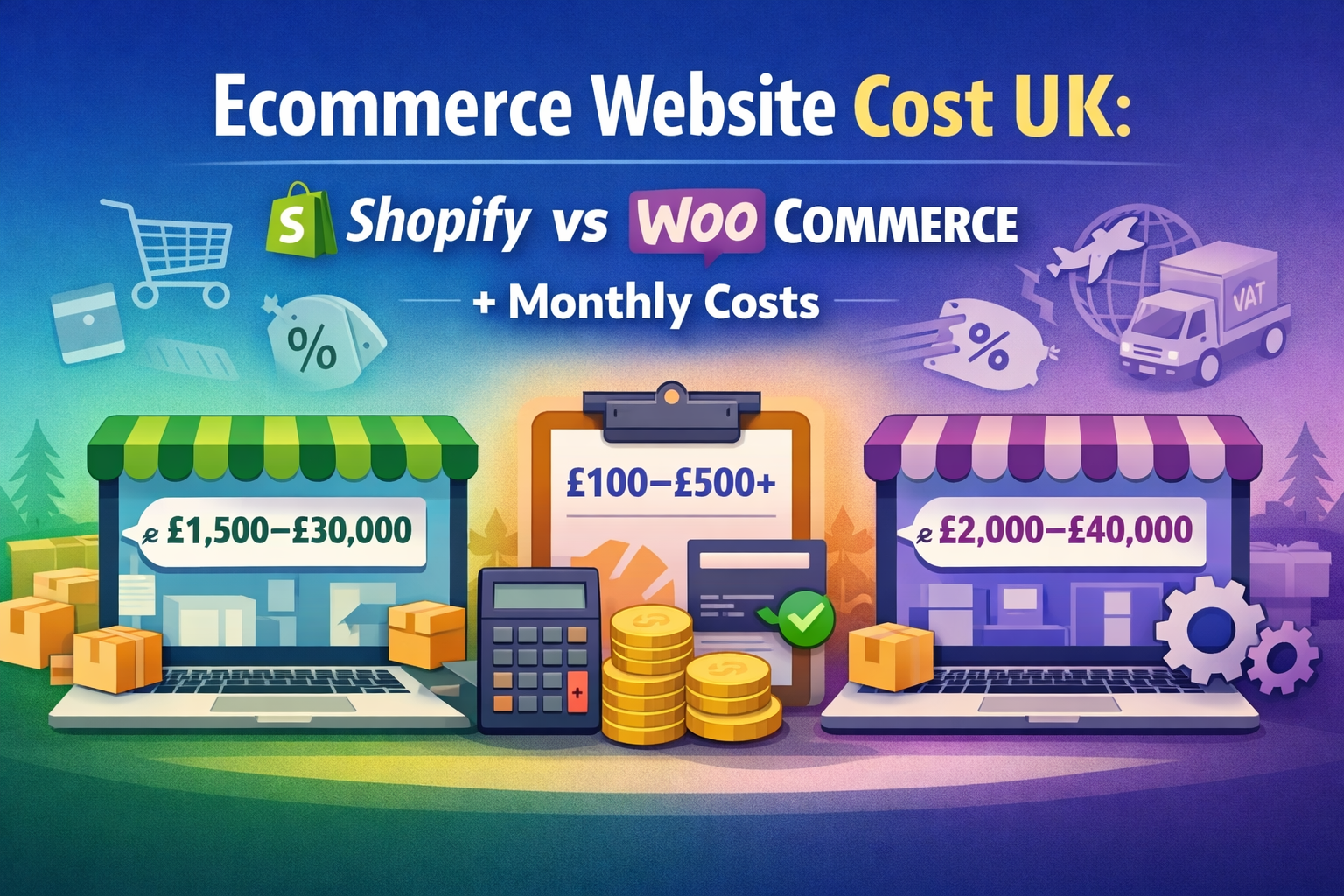
| Typical one-off build | £1.5k–£30k+ | £2k–£40k+ |
| Typical monthly platform/hosting | Subscription (commonly from £19/mo billed yearly on Basic) Shopify | Hosting £10–£80+ |
| Apps/plugins | Often higher (app ecosystem) | Flexible; can be low or high depending on extensions |
| Maintenance burden | Lower technical burden | Higher (updates, security, performance) |
| Best for | Fast, stable, low-tech-overhead ecommerce | Content-led brands, flexibility, custom workflows |
| Trade-offs | Ongoing costs + app reliance | More responsibility (or pay someone to handle it) |
Next steps:
If you’re still comparing broader website budgets, start with the hub post: Website Cost UK.
If you’re ready to talk build options and what makes sense for your product catalogue, see: Web Design South Wales.
When you’re ready, the fastest way to get an accurate quote is to share:
- approximate product count (and variations),
- shipping destinations/rules,
- payment methods,
- any subscriptions/B2B needs,
- and examples of stores you like.
Contact us now and we will help you map the most cost-effective route (without paying for features you’ll never use).